
The market can pay you for a decision you should not repeat.
A stock reaches your stop, and you hold it anyway, “just this one time.” It falls further, then comes back and keeps going. Relief arrives with a persuasive explanation: the rule was too cautious, your conviction was justified, and next time you should trust yourself again.
Mark Minervini describes this trap in Think and Trade Like a Champion. A trader skips a stop, the stock recovers, and “being rewarded for bad habits only reinforces them.” His verdict: “In the stock market, when bad habits get rewarded it leads to ruin.”
This article follows two such trades from AlpharvestPro’s dated record. Both broke the same rules on the same evening. Only one was rescued.
Two rules, written before the trade
William O’Neil’s loss rule states its exceptions in the title: “Always, without Exception, Limit Your Losses to 7% or 8% of Your Cost.” When a stock gets there, “You must sell without hesitation—no waiting a few days to see what might happen; no hoping the stock will rally back.”
Minervini adds a rule for the nights a stop cannot protect, when a company reports earnings: “My general rule of thumb is never hold a large position going into a major report unless I have a reasonable profit cushion.” With “no profit, or worse I’m at a loss, I usually sell the stock or cut down my position size to guard against the possibility of a 10 to 15 percent gap against me.”
Both rules assume you will often be wrong. “On average, over time you will likely be correct on only 50 percent of your purchases,” Minervini writes. The rules decide what the other half costs.
Two breakouts from one group
Braze (NASDAQ: BRZE) and ServiceTitan (NASDAQ: TTAN) both sit in the app’s Computer Sftwr-Enterprse industry group. Both joined AlpharvestPro’s VCP Setup (Minervini) list in late August 2026: BRZE on August 21 with RS 85, TTAN on August 24 with RS 83. Both were also on RS Leaders and the Minervini Trend Template.
Each plan buys when the stock trades above the top of its last two weeks’ range, sets O’Neil’s 8% stop, and risks 1% of a hypothetical $40,000 account ($400).
| BRZE | TTAN | |
|---|---|---|
| Buy point | $31.43, the August 21 high | $96.76, the August 20 high |
| Breakout | August 24, on volume 2.65 times average | August 27, on volume 1.42 times average |
| 8% stop | $28.92, $2.51 a share | $89.02, $7.74 a share |
| Size | 159 shares, $4,997.37, 12.5% of the account | 51 shares, $4,934.76, 12.3% of the account |
Together the two positions held about a quarter of the account in one industry group.
Tuesday, September 8, 2026
TTAN had already failed. It reached $102.95 on August 28, then slid. On September 2 it dropped off VCP Setup, RS Leaders and the Trend Template. On September 4 it traded down to $87.71, through the stop, so the plan sold at $89.02 for a loss of $394.74. A trader who skipped that stop still held it at the September 8 close of $81.58, 15.7% below cost.
BRZE had given back its cushion. It reached $35.02 on August 28, 11.4% above the buy point, about the cushion Minervini says can justify holding into a report. By the September 8 close it was $30.31, 3.6% below cost, on volume 2.77 times average. The stop had not been touched, and that night BRZE was still on VCP Setup, RS Leaders and the Trend Template, with RS 81.
Both companies reported after the close. Braze’s results webcast was set for 4:30 p.m. Eastern time and ServiceTitan’s call for 5:00 p.m.
| Plan for the evening | BRZE | TTAN |
|---|---|---|
| A. Follow both rules | Sell at the close, $30.31: −$178.08 | Already sold at the stop: −$394.74 |
| B. Follow the stop only | Hold into the report, with the $28.92 stop in place | Already sold at the stop: −$394.74 |
| C. “Just this one time” | Hold and ignore the stop | Hold at $81.58 and ignore the stop |
Minervini’s rule also allows cutting the position size instead of selling; plan A takes the full sale.
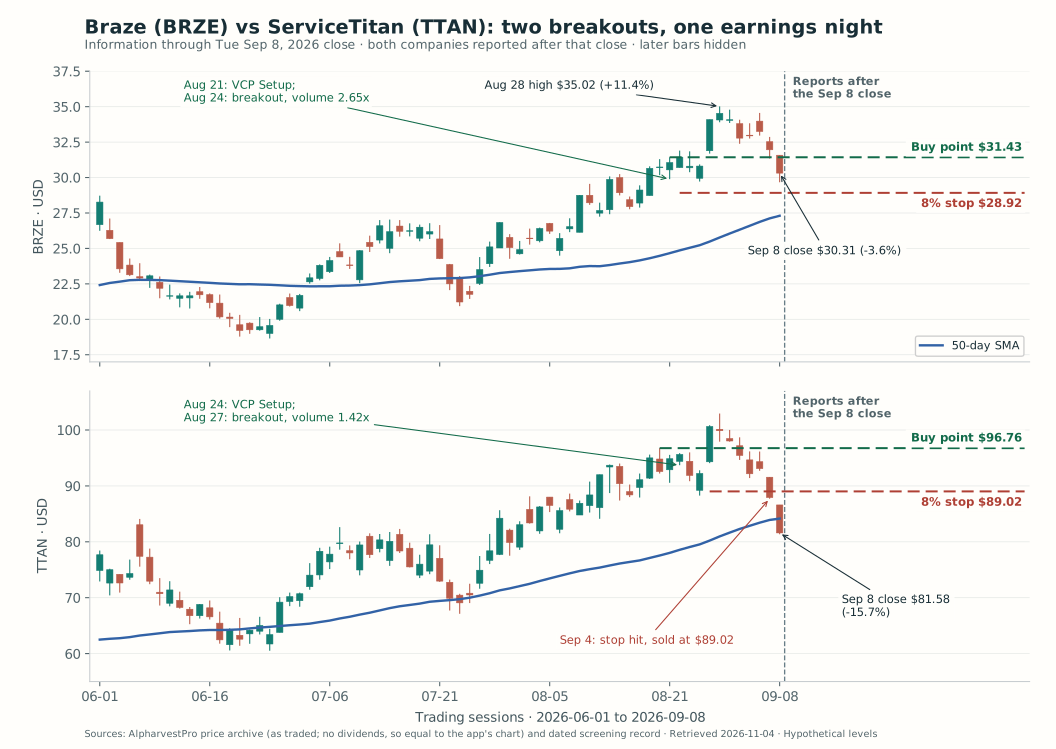
Blue: 50-day SMA. Green dashed: buy points. Red dashed: 8% stops. Gray: the September 8 close. Tap or click any chart to open it at full size.
Which plan would you be willing to repeat a hundred times?
Reveal BRZE and TTAN through November 3
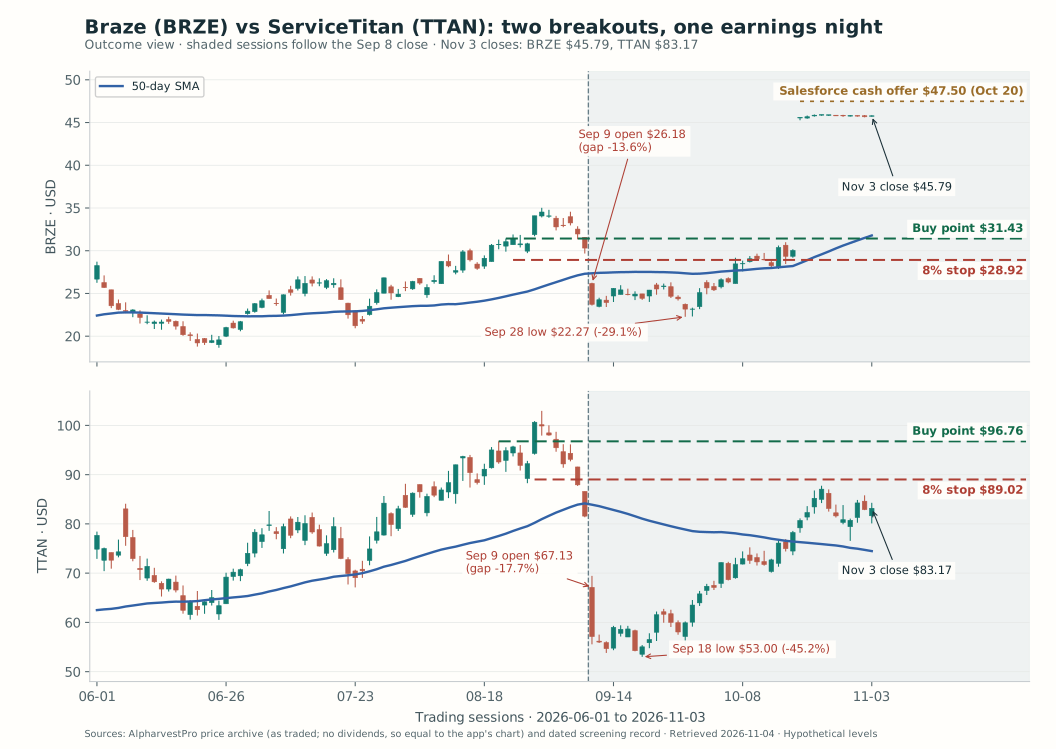
September 9. BRZE opened at $26.18, 13.6% below the previous close, inside the 10 to 15 percent range Minervini’s rule guards against, and 16.7% below the buy point. A stop order cannot fill above the open, so plan B sold there for −$834.75, 2.1 times the planned risk. TTAN opened 17.7% lower at $67.13 and closed at $57.12, on volume 17 times average. SPY, the S&P 500 ETF, fell 0.5% that day: these were company reports, not a market break. That night BRZE dropped off VCP Setup, RS Leaders and the Trend Template.
Plan C, the hole. TTAN fell to $53.00 on September 18, 45.2% below cost: an open loss of $2,231.76, 5.7 times the planned risk. BRZE fell to $22.27 on September 28, 29.1% below cost, an open loss of $1,456.44. Along the way AlpharvestPro listed BRZE on two short setups, Bear Flag Continuation (Morales & Kacher) on September 15 and Head & Shoulders Top (O’Neil / Morales) on September 30. At the worst close for the pair, September 11, plan C was down $3,336.99, 8.3% of the account.
October 20. Salesforce agreed to buy Braze for $47.50 a share in cash, 58.1% above the October 19 close of $30.04. BRZE opened at $45.53 on volume 25.6 times average and then barely moved: through November 3 it traded between $45.26 and $45.94. TTAN had no buyer.
| Result on November 3 | BRZE | TTAN | Both |
|---|---|---|---|
| A. Follow both rules | −$178.08 | −$394.74 | −$572.82 |
| B. Follow the stop only | −$834.75 | −$394.74 | −$1,229.49 |
| C. “Just this one time” | +$2,283.24 at $45.79, 5.7 times the planned risk | −$693.09 at $83.17 | +$1,590.15 |
Plan C made the most money. That is the terrible lesson. On October 19, the day before the bid, the same plan was down $1,164.51. Its profit came from one announcement that no chart, list or rule could have forecast, and it arrived after plan C had been down 8.3% of the account.
Minervini puts it as two people crossing a busy road: one looks both ways and is hit, the other runs across blind and makes it. He asks what would happen “if this scenario was repeated 100 times?” and answers: “The result does not justify the means.” O’Neil needs five words: “Any stock can do anything.”
The rules also did not lock anyone out of BRZE. It returned to RS Leaders and the Trend Template on October 7 and to VCP Setup on October 8: a new setup, open to a new plan with a new stop.
Keep two records
O’Neil: “Do your own postanalysis by plotting your past buy and sell points on charts.” Minervini: “One of the healthy habits of trading is conducting a post-analysis of your results on a regular basis.” The review needs two columns.
The financial record is what happened: entry, exit, size, costs and the effect on the account. The decision record is what you knew, what the plan required and what you did. Graded on decisions, the November 3 table reads in reverse:
- Plan A followed both rules and lost the least.
- Plan B kept the stop but held a losing position into a report, the case Minervini’s rule is written for. The gap cost 2.1 times the planned risk.
- Plan C broke two rules on two stocks, sat through a drawdown of 8.3% of the account, and made money only because of a takeover bid.
A planned trade can lose and a broken rule can win. If only losing departures from the plan get reviewed, the winning ones quietly train the habit. Try it on your own records: pick a profitable trade, hide the profit column, and reconstruct what you knew before each decision. Would you repeat those actions if the next move had gone the other way? Then do the same for a loss that followed the plan.
Review can change the rules too. The difference is between revising a rule after studying many trades and dropping it in the middle of a live one because the position hurts.
What the example cannot show
BRZE and TTAN were chosen after the outcome was known, and they are only two stocks. BRZE’s gain came from a takeover, which no method foresees, and TTAN recovered part of its loss without one. Plan B shows that a stop is an order, not a guarantee: a gap fills it below its price. Plan A assumes a sale at the closing price. Two positions in one group, reporting the same evening, were closer to one bet than two. Lists cannot see report dates or deal talks: by November 3, the bid had given BRZE RS 99 and a Minervini Score of 10. Nothing here measures how often any rule works, or how AlpharvestPro’s lists perform.
Running it in AlpharvestPro
- Find the setup: VCP Setup (Minervini) is one starting list. A stock’s Industry Group appears in its diagnostic view; two candidates from one group are related bets.
- Check the calendar before buying: AlpharvestPro does not show report dates, so look up the next one on the company’s investor-relations page. If it comes before the position is likely to have a cushion, size down or wait.
- Size it: with 1% risk and an 8% stop, a position is 12.5% of the account. The position-size calculator does the arithmetic, and our CPAY example walks through it.
- Watch: Watchlist Alerts flag a starred stock’s new list entries, short lists included. BRZE joining Bear Flag Continuation (Morales & Kacher) on September 15 was one.
- Review weekly: keep both records for every closed trade. For the trades that work, our article on selling winners covers the exits.
The rules cost money on September 8 and earned nothing on October 20. They are still the only part of these trades worth repeating.
Reading and chart notes
William J. O’Neil, How to Make Money in Stocks, Chapter 7, on why any stock can do anything; Chapter 10, on limiting losses; Chapter 11, on postanalysis. Mark Minervini, Think and Trade Like a Champion, Section 2, on being right about half the time; Section 4, on post-analysis; Section 5, on rewarded bad habits, the road crossing and holding into a report. The plans, records and routine are this article’s own applications.
NASDAQ: BRZE; NASDAQ: TTAN. Daily prices are as traded, from the archive behind AlpharvestPro’s charts, retrieved November 4, 2026. Neither company pays a dividend, so the app’s chart shows the same prices. Report times come from the two companies’ September 8, 2026 releases, and the takeover terms from Braze’s Form 8-K for October 19, 2026. List appearances come from the dated screening record. The first chart ends at the September 8 close; the outcome chart ends November 3. Entries, stops, sizes and fills are hypothetical and exclude costs, slippage and taxes. The case was chosen after the outcome was known and does not measure how often any method works.

